
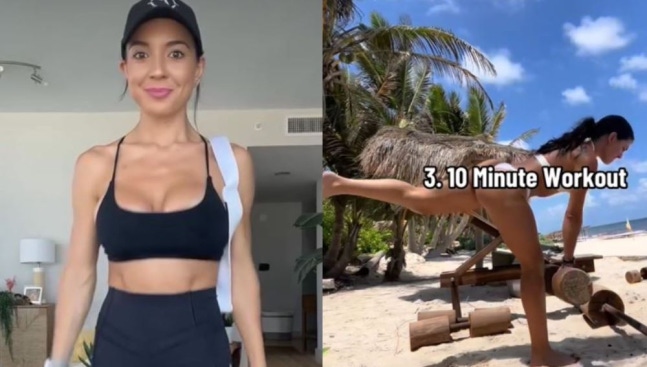
Worried about gaining weight during your vacation? Follow these ‘4 rules’ even while on vacation.
2024.07.25 16:40
I really minimize movement while on vacation.
If I just keep eating, I'll gain weight, right?
On top of that... it just so happens to be when I'm on vacation...
It has been raining continuously in the Gyeonggi and Gangwon regions...
Four things... will I be able to stick to them? Haha.
I manage to climb stairs, stay hydrated, and exercise for 10 minutes, but...
I don't think I'll be able to do yoga lol
-------------------------------------------------------------
A professional fitness trainer introduced four ways to maintain your weight while traveling.
According to the New York Post on the 24th (local time), Melissa Latari (32), a professional fitness trainer from Miami and a TikToker with approximately 273,000 followers, shared her methods for maintaining her weight while traveling. She said, "I gained 6kg while traveling last year, so to avoid repeating that mistake, I have four rules I follow while traveling." Melissa continued, "These are using the stairs at my accommodation, exercising for at least 10 minutes, staying hydrated, and doing yoga." She added, "Even though they are basic, it is often difficult to stick to them while traveling." People who usually manage their diet and exercise well may worry about gaining weight when going on a trip or vacation because their eating habits and lifestyle change. In such cases, try following the four tips Melissa shared.
▷Climbing the stairs at the accommodation= Climbing stairs is an energy-intensive exercise, and its advantage lies in the fact that it can be done anytime, anywhere, as long as there are stairs. Developing a habit of using stairs not only increases activity levels but also helps improve cardiovascular function and strengthen lower body muscles. Strengthening thigh muscles reduces the burden on knee joints, which helps prevent arthritis. Climbing stairs burns nearly twice as many calories as walking on flat ground, making it highly effective for weight loss. Typically, climbing one step burns about 0.15 kcal, while descending one step burns about 0.05 kcal. Based on a 30-minute session, walking on flat ground burns about 120 kcal, whereas climbing stairs burns approximately 220 kcal. Therefore, it is beneficial for preventing obesity and helps improve physical fitness and strengthen lower body muscles evenly.
▷Exercise for 10 minutes= Melissa recommended exercising for at least 10 minutes while traveling. She selected planks and squats as simple exercises. Planks help strengthen the glutes and abdominal muscles. Lie face down on the floor, bend your elbows, and lift your body. Support your body with both arms and feet, pulling your toes towards your shins. Maintain a 90-degree angle with your elbows, and ensure your head and body are in a straight line. Squats are a representative exercise for building lower body muscles. Here is how to perform a squat: First, stand with your feet shoulder-width apart and your toes pointing slightly outward. Then, sit down until your thighs are parallel to the ground, ensuring your knees do not extend past your toes. During this process, keep your back and waist straight to maintain your center of gravity, which helps maintain upper body balance and prevents back injuries. Finally, stand back up by engaging your thigh muscles, feeling as if you are pushing off the ground with your heels.
▷Water intake= Melissa drinks more than 2 liters of water while traveling. Water aids in metabolic processes once it enters the body. Drinking water frequently facilitates the elimination of waste products, and since calories are consumed to digest the water itself, it even has a weight-loss effect. It is particularly beneficial to drink water before meals. Filling the stomach with water reduces feelings of hunger, which can help reduce food intake. It is appropriate to drink about 500ml of water 30 minutes before a meal. Regularly consuming an adequate amount of water also helps suppress appetite. Drinking water makes it easier to manage "false hunger." If you crave spicy food even after having eaten, you should consider it false hunger. In such cases, drinking a glass of water can reduce the desire for food.
▷Doing Yoga= To relieve fatigue accumulated during travel, it is better to move around, even if only a little. This is called "dynamic rest." Dynamic rest stimulates blood circulation, which facilitates the efficient delivery of oxygen to every part of the body and effectively breaks down fatigue-causing substances such as lactic acid and ammonia. Lactic acid and ammonia are substances produced when muscles are overused and are the main causes of fatigue and muscle pain. Yoga is a prime example of dynamic rest that improves flexibility and helps build a balanced physique. By practicing various poses, one learns to sit upright and regulates the autonomic nervous system, thereby enhancing a sense of balance.

Comments1


Most Engaging Posts in the Community
- 01CommentsYou make sure to keep my skin from drying out in between.326626.11.05
- 02CommentsYou applied the blush with a puff. It feels like chewy dough.276626.11.05
- 03CommentsTidy up your lip line, too. Haha, you look pretty when you apply lipstick.285626.11.05


- 01CommentsI really like the color. I'm a bit awkward with blush, so I think it'll be fine even if the staying power is short.3572026.10.25
- 02CommentsThe vanilla color has a subtle cream tint, so I think it will be easy to coordinate with various outfits.3323026.10.28
- 03CommentsFor eyebrows, longevity is important, but I think it's also important whether they draw naturally.1772026.10.27


- 01CommentsI always wonder what to wear every morning... haha. It's great that you organized this for me. I'll have to save this and refer to it. lol8,3714126.10.07
- 02CommentsA Chiikawa and The Saem collaboration? Even the packaging is so cute. I'm curious about the cosmetics, but I'm more tempted by the merchandise.4,5596426.10.19
- 03CommentsAs expected, Dior Holiday catches the eye right from the packaging. With the silver glitter pouch and added ribbon, it really feels like a perfect year-end gift.1,7732026.10.15


- 04
- 05
I did my first cleanse with cleansing milk again today.[7]
315626.11.05 - 07
I put cleansing powder in the cleanser and wash my face.[7]
265626.11.05 - 08
Apply eyelash serum and skip mascara[8]
254426.11.05 - 09
- 10


- 04
When your skin breaks out, just use these 3!! (I saw real results)[12]
1673026.10.28 - 05
- 06
I use Pawpaw cream instead of Vaseline.[13]
1426626.10.27 - 07
- 08
- 09
The Lab by Blanc Doux foam cleanser I bought at Daiso![22]
1407626.10.25 - 10


- 04
- 05
- 06
Tekira Glaze Jelly Beam Highlighter ✨ My Honest Review & How to Apply[13]
1,1355126.10.12 - 07
- 08
MAC Thanks It's MAC vs. Hug Me Swatch Comparison (Cool-toned swatches ⭕)[5]
1,0141126.10.13 - 09
- 10


