

주먹쥐고일어섯

Since ultraviolet rays cause pigmentation such as freckles, age spots, and blemishes, as well as redness and aging, sunscreen is essential year-round, but you must make sure to apply it especially during the summer.
When choosing sunscreen, you typically consider SPF and PA ratings. The SPF index indicates the degree of protection against ultraviolet B (UVB) rays, while the PA index indicates the degree of protection against ultraviolet A (UVA) rays. It is known that UVB rays can cause burns or cancer, while UVA rays age the skin, leading to wrinkles and age spots.
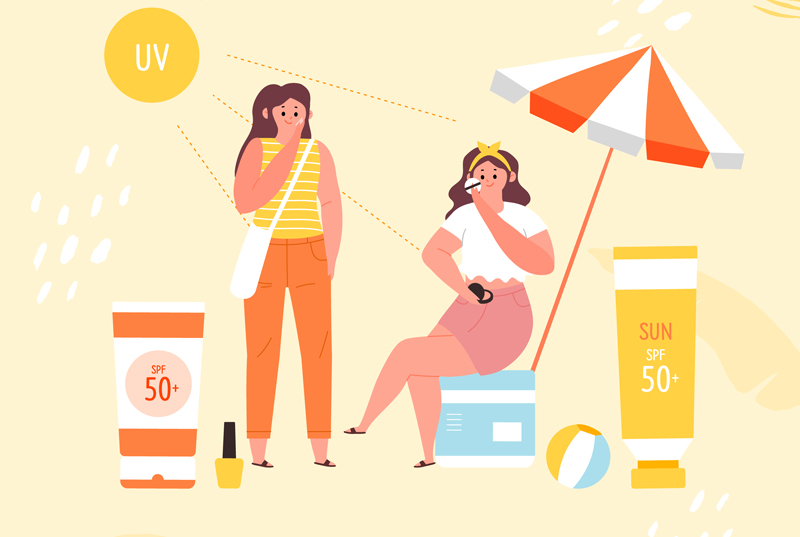
The number following SPF indicates that the amount of UV rays reaching the skin is reduced to one-n compared to when no sunscreen is applied. For example, SPF 30 means that the amount of UV-B rays reaching the skin is reduced to one-thirtieth. Instead of a number, a plus sign (+) follows PA; one plus sign indicates that the probability of blocking UV-A rays is 2 to 3 times higher, while two plus signs indicate 4 to 7 times higher.
A high SPF does not necessarily mean a sunscreen is always better. This is because it may contain many ingredients that can cause allergies.
If you do not go out often, choose a product with around SPF 10 and PA+. For light outdoor activities, it is recommended to use a product with SPF 10 to 30 and PA++. When spending a long time outdoors, such as hiking or sports activities, you can use a product with SPF 30 to 50 and PA+++.
[source] Common misconceptions about summer skincare | Author Haeundae Yonsei Medical
